
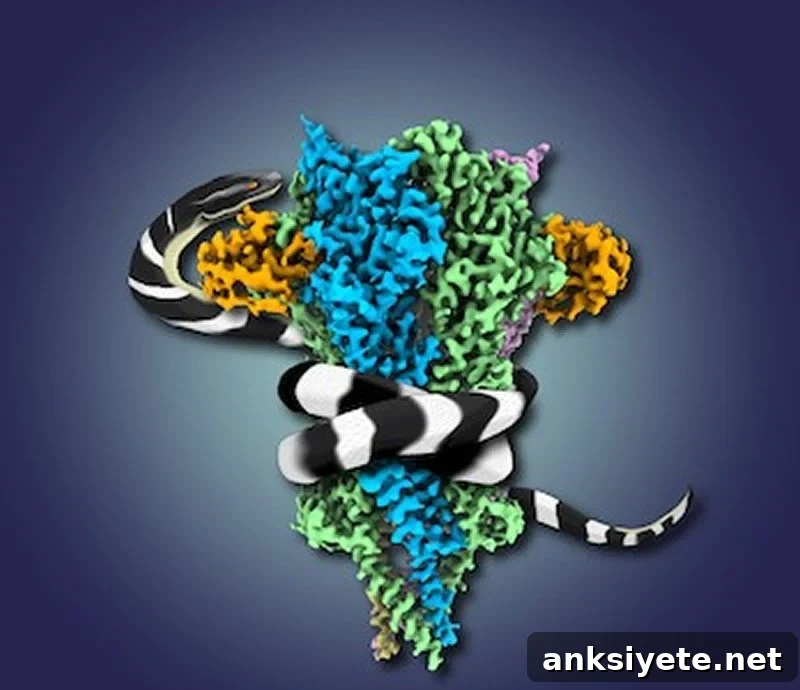
Summary: A neurotoxin found in snake venom enabled researchers to reveal a high-resolution structure of the nicotinic receptor that triggers muscle contraction.
Source: UT Southwestern Medical Center
Researchers at UT Southwestern Medical Center have determined the detailed, near-atomic structure of a key protein that mediates rapid communication between nerves and muscles. Published in Neuron, this work improves understanding of how the muscle-type nicotinic acetylcholine receptor works and offers structural insight into congenital myasthenic syndromes (CMS), a group of genetic conditions that cause muscle weakness.
The nicotinic receptor sits on the surface of motor nerve terminals and across from muscle cells at the neuromuscular junction. When the neurotransmitter acetylcholine is released from a nerve ending, binding to this receptor triggers an ion channel to open, producing the electrical signal that causes a muscle to contract within milliseconds. Because the receptor is embedded in the cell membrane, solving its structure has been technically difficult.
“The neuromuscular nicotinic receptor has been a focus of investigation for more than a century,” says Ryan Hibbs, Ph.D., associate professor of Neuroscience and Biophysics at UT Southwestern and a corresponding author of the study. “It was the first ion channel to be purified, to have its genes cloned, and to be imaged by electron microscopy, yet a high-resolution picture of the native, muscle-type form remained elusive.”
Prior efforts using X-ray crystallography and earlier generations of cryo-electron microscopy (cryo-EM) produced only low-resolution data. These approaches struggled because membrane proteins are difficult to crystallize and require approaches that preserve their native lipid environment.
To overcome this, the researchers took advantage of how certain snake venoms bind and immobilize the receptor. The team combined α-bungarotoxin, a neurotoxin that binds tightly to the receptor, with tissue from electric fish known to be rich in the muscle-type receptor (Torpedo electric organ). Binding the toxin stabilized the receptor and allowed the researchers to isolate sufficient quantities for structural study.
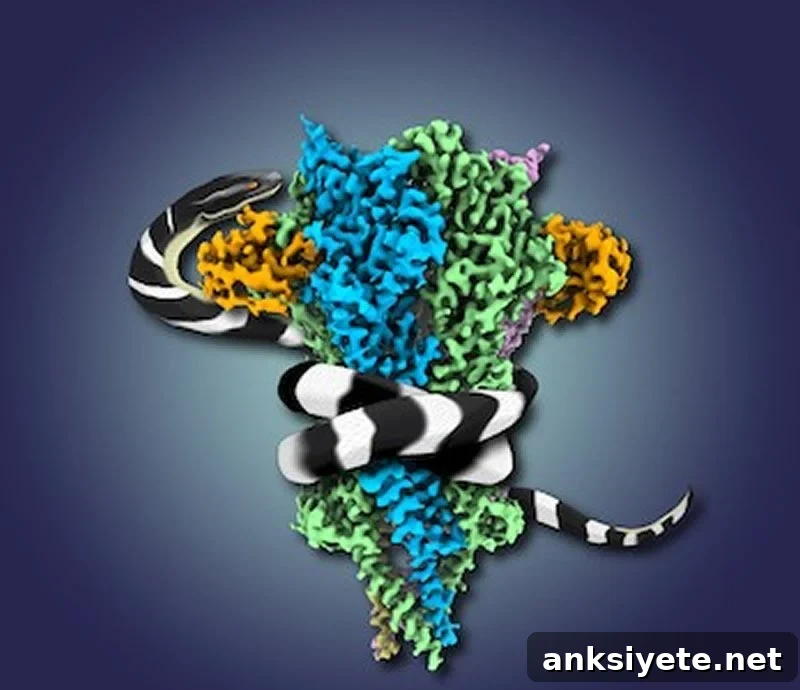
After flash-freezing the receptor-toxin complexes, the team applied modern cryo-EM methods that have rapidly improved in resolution in recent years. These advanced microscopes and image processing approaches made it possible to resolve the receptor’s architecture at a near-atomic level. “This could not have been achieved using X-ray crystallography despite decades of attempts,” Hibbs notes. “At this resolution we can precisely place most of the more than 2,000 amino acids that make up the receptor.”
The structure shows two toxin molecules bound at the receptor’s subunit interfaces, occupying the same binding sites used by acetylcholine. By competing for those sites, the toxin locks the receptor into a closed conformation and prevents the ion channel from opening. The detailed map explains why α-bungarotoxin binds so tightly and selectively, and it clarifies the molecular basis for the paralysis caused by such venoms.
Beyond the toxin interaction, the high-resolution model illuminates functional features of the receptor that are relevant to human disease. Lead author Md. Mahfuzur Rahman, Ph.D., a postdoctoral researcher in the Hibbs lab, reports that mapping CMS-associated mutations onto the new structure revealed three principal regions where such mutations cluster. These regions help explain how specific changes in receptor structure impair gating or ion flow, producing the muscle weakness seen in affected patients.
The study’s co-authors include Jinfeng Teng and Colleen Noviello from UT Southwestern; Michael H.B. Stowell, Brady Worrell, and Myeongseon Lee from the University of Colorado, Boulder; and Arthur Karlin of Columbia University.
Funding: This research was supported by the Cancer Prevention and Research Institute of Texas (grant RP170644), the National Institutes of Health (grants GM12957, DA037492, DA42072, NS095899, AG061829), and the MCDB Neurodegenerative Disease Fund. The authors declare no competing interests. Ryan Hibbs is an Effie Marie Cain Scholar in Medical Research.
Original research: “Structure of the Native Muscle-type Nicotinic Receptor and Inhibition by Snake Venom Toxins.” Md. Mahfuzur Rahman, Jinfeng Teng, Brady T. Worrell, Colleen M. Noviello, Myeongseon Lee, Arthur Karlin, Michael H.B. Stowell, Ryan E. Hibbs. Neuron. doi: 10.1016/j.neuron.2020.03.012
About this neuroscience research article
Research highlights
• High-resolution structure of the native muscle-type nicotinic acetylcholine receptor
• Previously unresolved elements identified that contribute to neurotoxin binding
• α-Bungarotoxin stabilizes the channel in a closed conformation
• Structural framework for understanding gating and congenital myasthenic syndrome mutations
Please share this neuroscience news with colleagues and peers.