
Summary: Researchers explain why being born and raised in certain places can dramatically affect life expectancy.
Source: The Conversation.
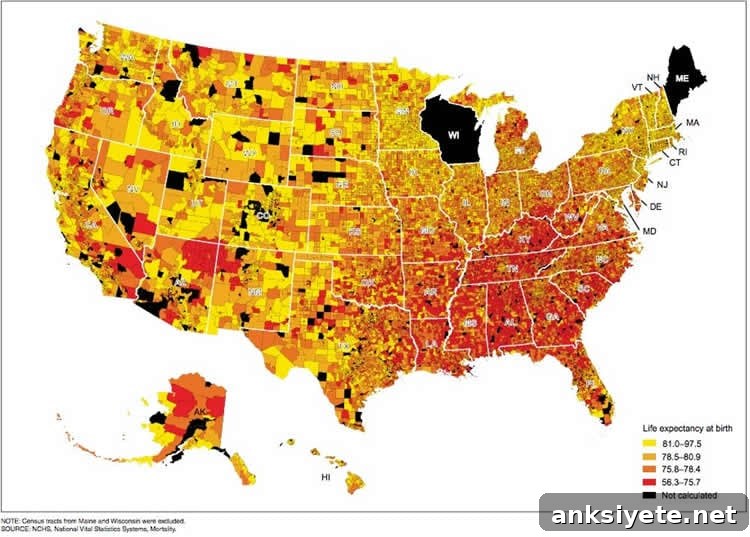
Newly released data on life expectancy across the U.S. shows that where we live has a major influence on how long we live.
A person in the United States now has an average life expectancy of about 78.8 years, according to the most recent numbers from the Centers for Disease Control and Prevention (CDC). But that national average masks very large differences by location, race and socioeconomic status.
Geography matters. A child born today in parts of Mississippi may not reach their 75th birthday, while a child born in many areas of California, Hawaii or New York can expect to live into the early 80s. These differences are not only between states: they can appear across short distances within a single city.
At the neighborhood level the contrasts can be stark. In Washington, D.C., for example, people living in the Barry Farms neighborhood face a life expectancy of 63.2 years. Fewer than 10 miles away, a baby born in Friendship Heights and Friendship Village can expect to live 96.1 years, based on CDC data. Ten miles can represent a difference of almost 33 years in expected lifespan—effectively the loss of a generation to premature death.
Across the country the range is even wider. Any two census tracts in the U.S. can differ in expected life expectancy by as much as 41.2 years, a staggering gap with profound social and economic consequences for families, communities and workplaces.
Recent increases in overdose deaths from the opioid epidemic and a rise in suicides have contributed to declines in overall life expectancy, particularly among working-class, middle-aged white Americans. Yet these factors alone do not explain the deep, persistent differences in lifespan tied to place, race and class.
Neighborhoods with larger Black populations often have lower life expectancies than majority-white, -Hispanic or -Asian neighborhoods. Research suggests these patterns reflect the unequal conditions of places where people live rather than inherent individual differences. Black communities are less likely to have consistent access to resources that support health—such as grocery stores that sell fresh food, safe and convenient places to exercise, and high-quality health care facilities—even in some middle-class areas.
Communities with lower life expectancy also tend to have fewer economic opportunities: higher unemployment, limited access to stable jobs, and lower-quality schools. These economic conditions shape health over a person’s lifetime. Children who grow up in economically distressed places are more likely to experience worse outcomes as adults.
Income is tightly linked to longevity. Research by Raj Chetty and colleagues has shown that lower incomes are associated with shorter lifespans in the U.S. Income and other resources are distributed unevenly across places, and that uneven distribution often reflects long-standing differences in public investment for education, infrastructure and social supports.
Where you live, your race and your socioeconomic status therefore interact to shape health and life expectancy. Local and state policies can make a difference. Studies indicate that higher levels of local government spending on social and public services are associated with improvements in life expectancy, especially for lower-income residents.
From a public health perspective, investments that change local environments can help increase life expectancy. Practical measures include improving access to healthy foods, creating and maintaining safe spaces for physical activity, supporting smoking cessation, and making quality health care more available. Policies that reduce the effects of racial segregation and expand economic opportunity—such as funding for quality education, safe and affordable housing, and accessible public transportation—also have the potential to narrow disparities in lifespan.
Life expectancy is not the only or the perfect measure of health and well-being, but it is a useful indicator of how well a nation is doing at ensuring long, healthy lives for all its residents regardless of where they live. Addressing the place-based drivers of health could prevent premature deaths and improve the social and economic fabric of communities across the country.
Source: Jessica Young – The Conversation
Publisher: Organized by NeuroscienceNews.com.
Image Source: NeuroscienceNews.com image is credited to NCHS, National Vital Statistics Systems, Mortality.
The Conversation. “Being Born in the Wrong Zip Code Can Shorten Your Life.” NeuroscienceNews. 14 October 2018. NeuroscienceNews.com.