
Summary: New research identifies a potential connection between the molecular events that form inhibitory synapses and autism risk.
Source: Utrecht University
Inhibitory Synapse Formation Reveals a Surprising Link to Autism
Neurobiologists Cátia Frias and Corette Wierenga have investigated how inhibitory synapses form in the brain and discovered an unexpected connection to autism. Their study highlights a role for the receptor tyrosine kinase MET — a protein already recognized as an autism risk factor — in the stepwise process by which inhibitory synapses are established. The findings were published in the Journal of Neuroscience on 26 March 2019.
“Brain cells communicate via synapses,” explains Corette Wierenga. “Most synapses are excitatory and increase the activity of the receiving neuron, but roughly 10–20% are inhibitory and act to reduce neuronal activity. Inhibitory synapses were understudied until fairly recently, yet they play a crucial role as directors that shape excitatory circuits.”
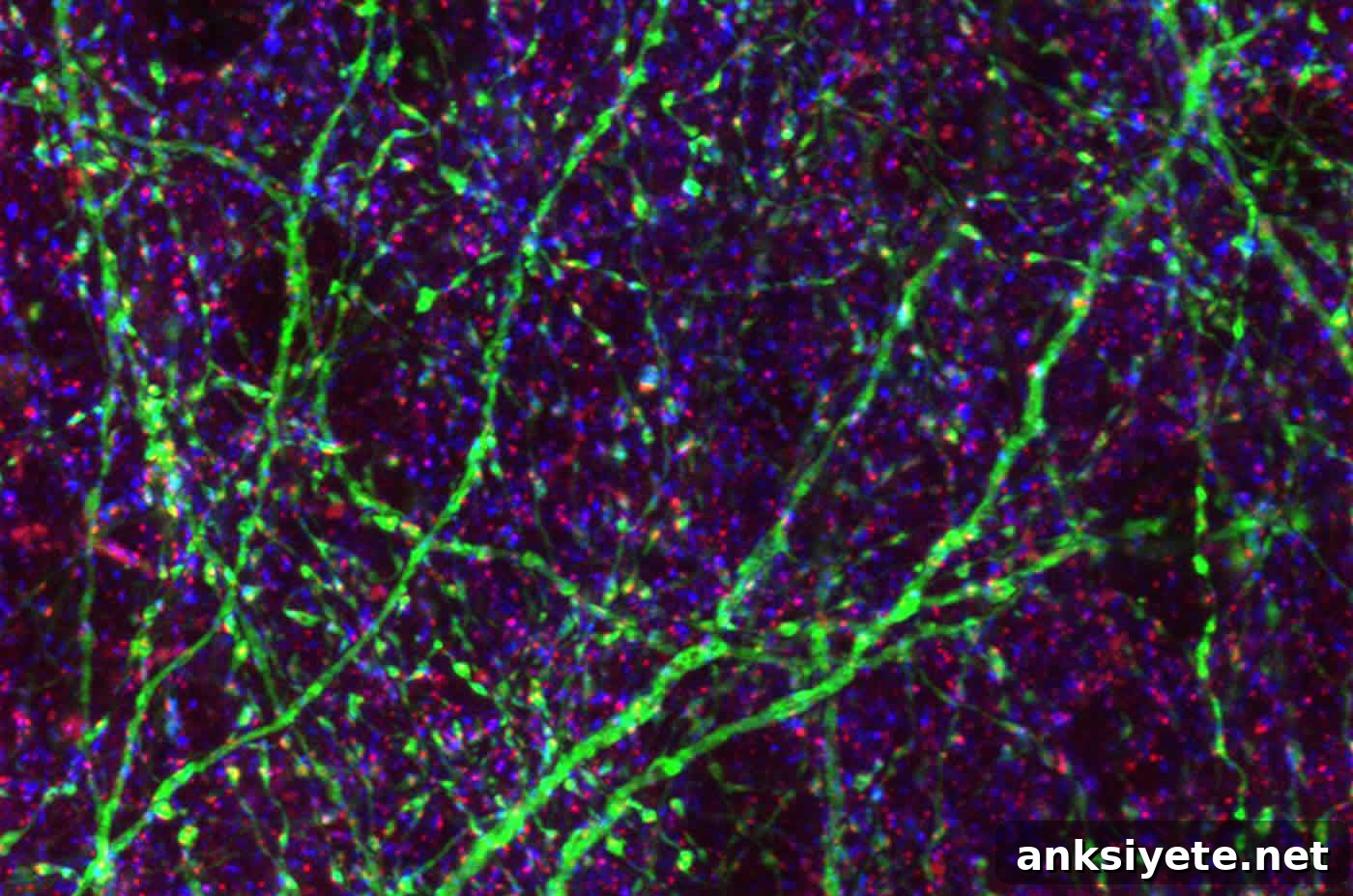
Microscopic image: Several neurons are highlighted in green. Colored dots mark inhibitory synapses contacting green and surrounding cells. Image credit: Frias et al.
Slices of Mouse Brain and Live Imaging
Synapses are dynamic structures that are continuously formed and eliminated, especially during learning and experience-dependent rewiring. To study how inhibitory synapses form, the researchers used two-photon microscopy to observe living neurons in organotypic hippocampal slices from mice. The neurons were visualized with fluorescent proteins, allowing individual presynaptic boutons and nascent synaptic contacts to be tracked over time.
A Snapshot Every 10 Minutes Reveals Sequential Steps
The team captured images every 10 minutes across a two-hour period to distinguish stable synapses from those being formed or dismantled. This time-lapse approach showed that the emergence of an inhibitory synapse is not an instantaneous on/off event but a multi-step sequence of molecular changes. The researchers followed one signaling pathway in detail and identified a chain of events that begins with bouton stabilization, proceeds to recruitment of synaptic vesicles, and culminates with postsynaptic assembly and functional maturation within 24 hours.
Importantly, the study demonstrates that presynaptic boutons become responsive to a particular signaling molecule, Semaphorin4D (Sema4D), only at a specific stage of synapse formation, and that this sensitivity is modulated by network activity. This activity dependence suggests that experience and neuronal firing patterns can gate the timing of inhibitory synapse development.
Actin Remodeling and the Role of MET
At the intracellular level, stabilization of presynaptic boutons required rapid remodeling of the actin cytoskeleton. Experimentally, actin depolymerization with Latrunculin B or reduction of ROCK activity could mimic the bouton-stabilizing effects of Sema4D, indicating that actin dynamics are central to the process.
Crucially, the cascade initiated by Sema4D requires activation of the MET receptor. MET has been identified previously as a genetic risk factor for autism spectrum disorders, and this study reveals a novel presynaptic role for MET at inhibitory synapses. Using a viral strategy to reduce MET expression specifically in inhibitory neurons, the authors found those axons no longer responded to Sema4D, underscoring MET’s necessity for Sema4D-induced bouton stabilization and subsequent synapse maturation.
Implications for Neurodevelopmental Disorders
GABAergic (inhibitory) synapses exert major control over neuronal excitability and circuit balance. Disruptions in inhibitory synapse formation and maintenance have been implicated in several neurodevelopmental conditions. The discovery that MET contributes directly to presynaptic events during inhibitory synapse formation provides a plausible mechanistic link between an established autism risk factor and altered circuit development.
The study offers detailed, dynamic insight into how inhibitory synapses form in response to a specific signaling molecule, how actin remodeling underlies bouton stabilization, and how MET co-activation is required for these presynaptic changes. These results motivate further research into MET’s role at inhibitory synapses and how its dysfunction may contribute to the synaptic and circuit alterations observed in autism.
Source: Utrecht University
Media contacts: Corette Wierenga – Utrecht University
Image credit: Frias et al.
Original research
Title: Semaphorin4D induces inhibitory synapse formation by rapid stabilization of presynaptic boutons via MET co-activation
Authors: Cátia P. Frias, Jian Liang, Tom Bresser, Lisa Scheefhals, Matthijs van Kesteren, René van Dorland, Hai Yin Hu, Anna Bodzeta, Paul M. P. van Bergen en Henegouwen, Casper C. Hoogenraad and Corette J. Wierenga
Journal: Journal of Neuroscience, 26 March 2019. DOI: 10.1523/JNEUROSCI.0215-19.2019
Abstract summary
The authors used high-resolution two-photon imaging of GFP-labeled presynaptic boutons in hippocampal slices to show that Sema4D rapidly stabilizes nascent inhibitory boutons. Stabilized boutons recruit synaptic vesicles, accumulate postsynaptic scaffolding protein gephyrin, and become functional within 24 hours. Bouton sensitivity to Sema4D is stage-specific and regulated by network activity. Bouton stabilization depends on actin cytoskeleton remodeling and requires MET activation; reducing MET expression in inhibitory neurons abolishes Sema4D sensitivity. These findings reveal a detailed molecular pathway for activity-dependent inhibitory synapse formation and identify a new presynaptic role for MET, linking inhibitory synapse biology to autism risk.