
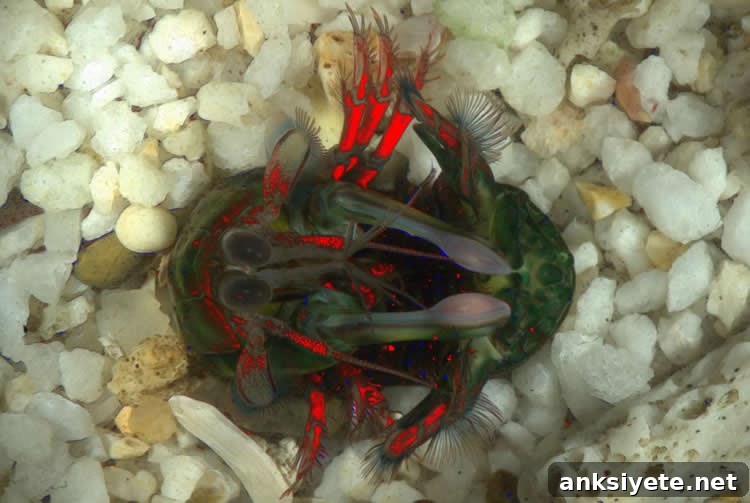
Researchers at the Queensland Brain Institute, The University of Queensland, have identified a previously unknown form of covert light-based communication used by marine animals.
The discovery has potential applications in satellite remote sensing, biomedical imaging, early cancer detection, and novel approaches to optical data storage.
Earlier work by Dr. Yakir Gagnon, Professor N. Justin Marshall and colleagues revealed that the mantis shrimp (Gonodactylaceus falcatus) can both reflect and detect circularly polarized light—a rare capability in the natural world. Until now, the biological function of that ability has been unclear.
The new study demonstrates that mantis shrimp produce circularly polarized signals as a covert way to advertise their presence to rivals while remaining hidden from many predators and other observers.
“On land we recognise colour as a primary signaling channel; on coral reefs many fish display vivid colours. What we’re uncovering now is an entirely different visual language,” said Professor Marshall. “Polarisation gives animals a way to communicate that can be invisible to most other species.”
Light can be polarized in different ways. Linear polarization oscillates in a single plane, while circular polarization propagates as a spiral, either clockwise or counter-clockwise. Very few animals perceive circular polarization, and that rarity makes it an effective covert channel.
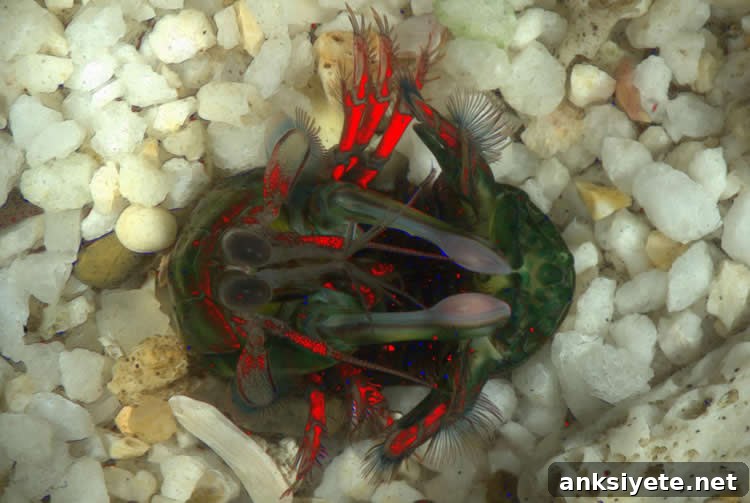
The researchers mapped circularly polarized reflections on mantis shrimp bodies and found strong signals on the legs, head and heavily armored tail—areas prominently exposed when the animals adopt a curled, defensive posture during disputes.
“These mantis shrimp live in burrows on the reef,” Professor Marshall explained. “They are secretive by nature and prefer to remain concealed rather than openly visible.”
To test how circular polarization affects behaviour, the team offered individual mantis shrimp a choice between two artificial burrows in a laboratory tank. One burrow reflected ordinary, unpolarized light while the other reflected circularly polarized light. The shrimp selected the unpolarized burrow about 68% of the time, indicating an aversion to the circularly polarized burrow that the animals treated as if it were occupied by another shrimp.
“When a hole emits circularly polarized light, shrimps avoid it as though another shrimp is present,” Professor Marshall said. “This suggests circular polarization functions as a private signal to conspecifics, allowing animals to advertise occupancy or territorial claims while remaining inconspicuous to many eavesdroppers.”
Beyond behavioral ecology, the findings have practical implications. Polarisation-sensitive imaging could enhance medical diagnostics because healthy and cancerous tissues scatter and reflect polarised light differently. “Cancerous cells do not reflect polarised light, particularly circular polarised light, in the same way as healthy cells,” Professor Marshall noted. Cameras fitted with circular polarisation sensors may therefore detect tumours or abnormal tissue earlier than conventional imaging techniques allow.
In related work published in the same issue of Current Biology, Professor Marshall and collaborators examined use of linear polarised light by fiddler crabs (Uca stenodactylus). These crabs inhabit mudflats, an environment that strongly polarises reflected light, and they respond to objects and surfaces based on how much polarised light they reflect.
“Fiddler crabs effectively have built-in polarizing filters, similar to the polarising sunglasses people wear to reduce glare,” Professor Marshall said. The crabs use polarisation cues to identify ground-based objects and to decide whether to approach in a mating display or retreat to their burrows, adjusting their behaviour according to the polarisation signature of visual targets.
“These animals operate in a visual currency invisible to humans,” Professor Marshall added. “Polarisation is emerging as an important and previously overlooked channel in animal communication.”
Funding: This research was supported by the Air Force Office of Scientific Research, the Asian Office of Aerospace Research and Development, and the Australian Research Council.
Source: Bernadette Condren, University of Queensland
Image Source: The image is in the public domain
Original Research: Gagnon, Y. L., Templin, R. M., How, M. J., & Marshall, N. J. “Circularly Polarized Light as a Communication Signal in Mantis Shrimps.” Current Biology. Published online November 19, 2015. doi:10.1016/j.cub.2015.10.047
Abstract
Circularly Polarized Light as a Communication Signal in Mantis Shrimps
Highlights
• Gonodactylaceus falcatus displays circularly polarized patterns across its body.
• The species can distinguish unpolarized light from circularly polarized light.
• Individuals show a natural aversion to burrows that emit circularly polarized light.
• G. falcatus likely uses circular polarization as a covert communication signal.
Summary
Animals that rely on conspicuous visual patterns to communicate face a trade-off: signals must be obvious to intended recipients yet concealed from predators, rivals, or parasites. One solution is to use a visual channel that is invisible to the organisms they wish to evade. Polarisation of light provides such a channel because sensitivity to polarisation varies widely across taxa. While many invertebrates detect linear polarisation, few animals perceive circular polarisation. Stomatopod crustaceans have evolved both the ability to produce circularly polarized reflections and the photoreceptor sensitivity to detect them. The present study demonstrates that Gonodactylaceus falcatus produces strong circularly polarized body patterns, can discriminate circular polarisation, and uses that information to avoid occupied shelters, supporting the idea that circular polarisation serves as a covert communication signal.
“Circularly Polarized Light as a Communication Signal in Mantis Shrimps” by Yakir Luc Gagnon, Rachel Marie Templin, Martin John How, and N. Justin Marshall. Current Biology. Published online November 19, 2015. doi:10.1016/j.cub.2015.10.047