
Summary: New preclinical research links the immune system to Alzheimer’s disease and suggests targeting complement C3 signaling could protect against neurodegeneration.
Source: Brigham and Women’s Hospital
Inhibiting the immune molecule complement C3 may offer a promising therapeutic strategy to slow or prevent neurodegeneration in Alzheimer’s disease.
During healthy brain development, a carefully regulated process called synaptic pruning removes excess or weak connections between neurons, refining neural circuits for better function. However, when immune-mediated pruning is misregulated later in life, it may contribute to synapse loss and neurodegeneration. Researchers at Brigham and Women’s Hospital report new preclinical evidence that the complement protein C3—a central component of the complement cascade in the innate immune system—plays a key role in this process and that reducing C3 activity can protect the aging brain against Alzheimer’s-related damage.
The study, published in Science Translational Medicine, focused on the role of complement C3, which previous research has shown is elevated in Alzheimer’s disease and can localize to amyloid plaques. C3 participates in synaptic refinement by tagging synapses for removal by microglia, the brain’s resident immune cells. Synapse loss is an early and critical feature of Alzheimer’s disease and correlates strongly with cognitive decline, yet it has been unclear whether blocking complement signaling could preserve synapses and cognitive function in later disease stages.
Using a well-established mouse model of Alzheimer’s disease (APP/PS1 mice) engineered to lack C3, the investigators assessed the effects of C3 deficiency in plaque-rich, aged animals. They found that aged APP/PS1 mice without C3 showed preserved synapses and neurons compared with APP/PS1 controls. These C3-deficient mice also demonstrated improved performance on learning and memory tasks despite having equal or greater amyloid plaque burden in the brain. In other words, reducing complement activity improved cognition and protected neural circuits even when amyloid accumulation persisted.
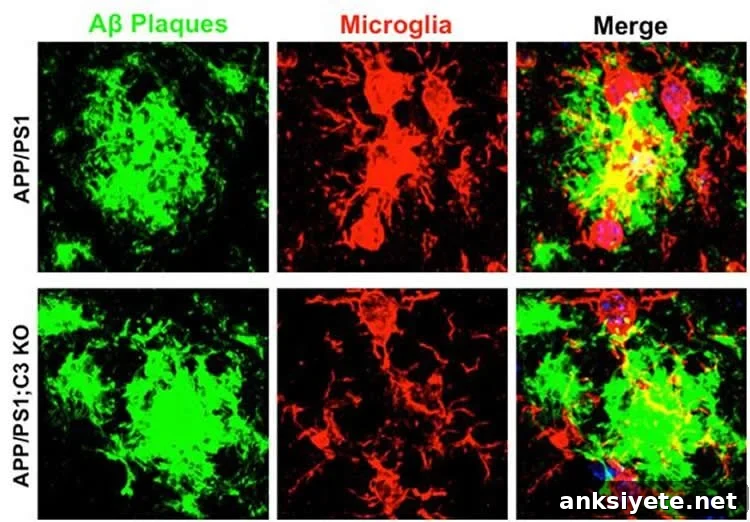
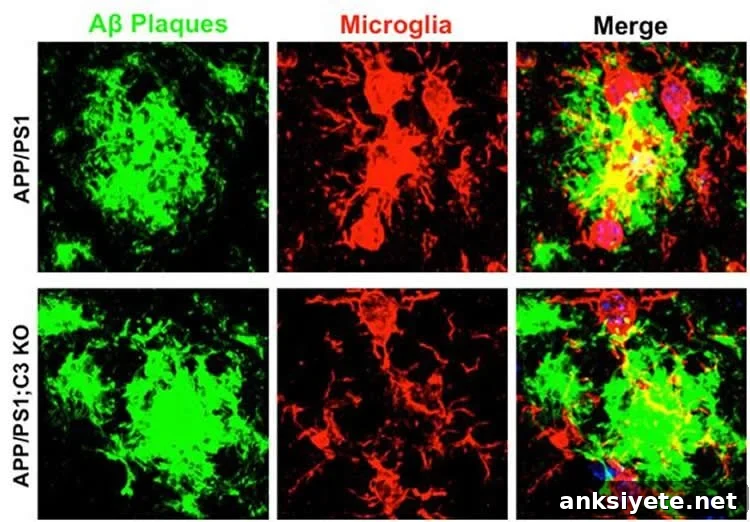
Detailed neuropathological analysis revealed that aged C3-deficient APP/PS1 mice had fewer microglia and astrocytes concentrated within the centers of hippocampal amyloid plaques and displayed lower levels of several proinflammatory cytokines. These findings suggest that C3 influences how glial cells respond to amyloid deposition and that reducing complement activation shifts microglial phenotypes away from a more inflammatory, potentially synapse-damaging state. The net effect was preservation of synapses and neurons and improved behavioral outcomes in aged animals.
“Amyloid plaque deposition often precedes memory loss by many years,” said Cynthia Lemere, PhD, corresponding author and a researcher at the Ann Romney Center for Neurologic Diseases at Brigham and Women’s Hospital. “Our results indicate that it may be the immune response to plaques—rather than plaques alone—that drives neurodegeneration in later stages of disease. Targeting complement pathways could therefore be a viable therapeutic approach.”
Complement C3 has been implicated in other central nervous system conditions beyond Alzheimer’s disease, including stroke and age-related macular degeneration, highlighting the broader relevance of complement biology in neuroinflammation and tissue injury. While translating findings from mice to humans presents well-known challenges—differences in immune system dynamics and lifespan, among others—the data support further investigation of complement modulation as a strategy to limit synapse loss, reduce neuroinflammation, and preserve cognition in Alzheimer’s disease.
Funding: The research was supported by the Fidelity Biosciences Research Initiative (F-PRIME), the NIH/National Institute on Aging (R21 AG044713), BrightFocus Foundation Fellowship, and the Edward R. and Anne G. Lefler Fellowship.
Source: Haley Bridger – Brigham and Women’s Hospital
Image source: Lemere Lab, Brigham and Women’s Hospital.
Original research: “Complement C3 deficiency protects against neurodegeneration in aged plaque-rich APP/PS1 mice” by Qiaoqiao Shi, Saba Chowdhury, Rong Ma, Kevin X. Le, Soyon Hong, Barbara J. Caldarone, Beth Stevens and Cynthia A. Lemere, Science Translational Medicine. Published online May 31, 2017. DOI: 10.1126/scitranslmed.aaf6295.
Abstract (summary)
Complement C3 is a central mediator of the complement cascade and contributes to synaptic pruning by microglia during development. Elevated C3 is observed in Alzheimer’s disease and associates with neuritic plaques. In this study, researchers examined aged APP/PS1 transgenic mice lacking C3 and found that C3 deficiency led to improved learning and memory despite increased amyloid plaque load. Aged C3-deficient mice exhibited fewer microglia and astrocytes concentrated within plaque centers, lower brain levels of proinflammatory cytokines, and protection against age-dependent synapse and neuron loss. The results indicate that complement C3 and downstream activation fragments modulate plaque-related pathology, glial responses, and neuronal dysfunction in this mouse model, supporting complement modulation as a potential therapeutic approach in Alzheimer’s disease.