
New relay circuits formed across sites of complete spinal transection result in functional recovery in rats.
Researchers at the University of California, San Diego and VA San Diego Healthcare have demonstrated extensive axonal regeneration at sites of severe spinal cord injury in rats, showing that early-stage neurons can survive, extend axons, and establish functional relay circuits across a completely transected adult central nervous system (CNS).
Study overview and approach
The team embedded neural stem cells in a fibrin matrix mixed with growth factors to create a supportive gel, then applied this gel directly to the site of complete spinal cord transection in rats. Fibrin is a protein involved in blood clotting and is already used in some human neuronal procedures, making the approach translationally relevant. The study tested whether grafted early-stage neurons could extend long-distance axons through the normally inhibitory adult CNS environment and form electrically active relays with host tissue.
Major findings
After six weeks, grafted neurons produced an extraordinary amount of axonal growth: the number of axons emerging from the injury site was roughly 200 times greater than previously reported, and axon lengths were approximately ten times longer than in earlier studies. Crucially, this structural regeneration translated into measurable functional recovery.
Adult host neurons above the lesion extended processes into the graft and connected with the implanted neurons, forming new relay circuits. Electrophysiological testing confirmed relay function: stimulating the spinal cord four segments above the injury evoked responses three segments below the injury, demonstrating signal conduction across the grafted region.
“We obtained the exact results using human cells as we had in the rat cells,” said Mark Tuszynski, MD, PhD, professor in the UC San Diego Department of Neurosciences and director of the UCSD Center for Neural Repair.
To verify that recovery depended on the newly formed relays, researchers re-transected spinal cords above the implant in animals that had recovered. The re-transection abolished the restored motor functions, confirming that the graft-mediated relay circuits were responsible for recovery.
Functional outcomes
Behavioral testing showed significant improvements. On a 21-point locomotor scale, untreated animals scored about 1.5, indicating severe impairment. Following stem cell grafting, average scores rose to approximately 7, reflecting restored ability to move all joints of the affected hind limbs. These gains indicate meaningful motor recovery rather than only microscopic or histological changes.
Human cell replication and tracking innovations
The team reproduced the results using two human neural stem cell lines, including one already undergoing clinical trials for amyotrophic lateral sclerosis (ALS), demonstrating cross-species applicability of the approach. The investigators also employed green fluorescent protein (GFP) labeling to visualize graft behavior. GFP tagging allowed direct observation of stem cells differentiating into neurons, extending axons, and making connections with host neurons—providing clear, time-resolved evidence of graft integration and relay formation.
According to the authors, these results show that early-stage neurons can overcome molecular inhibitors in the adult CNS that normally restrict growth. The findings therefore expand understanding of the regenerative capacity of neural stem cells and point toward clinically relevant strategies for repairing severe spinal cord injuries.
Notes about this regenerative medicine and spinal cord research
Additional contributors to the study include Yaozhi Wang, Lori Graham, Karla McHale, Mingyong Gao, Di Wu, John Brock, Armin Blesch, Ephron S. Rosenzweig, Binhai Zheng, James M. Conner, Leif A. Havton, and Martin Marsala. The work was supported by the Veterans Administration, the National Institutes of Health (NS09881), the Canadian Spinal Research Organization, The Craig H. Neilsen Foundation, and the Bernard and Anne Spitzer Charitable Trust.
Contact: Debra Kain – University of California – San Diego
Source: University of California San Diego press release
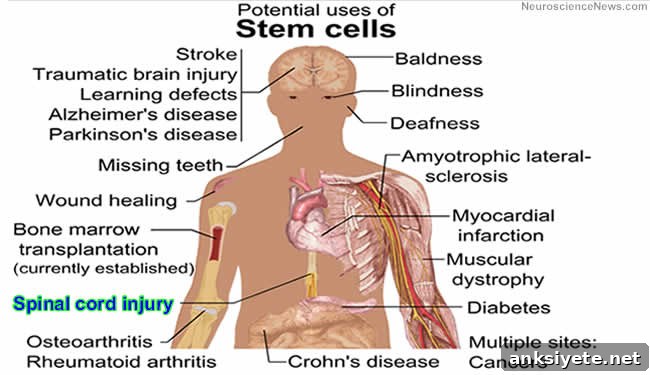
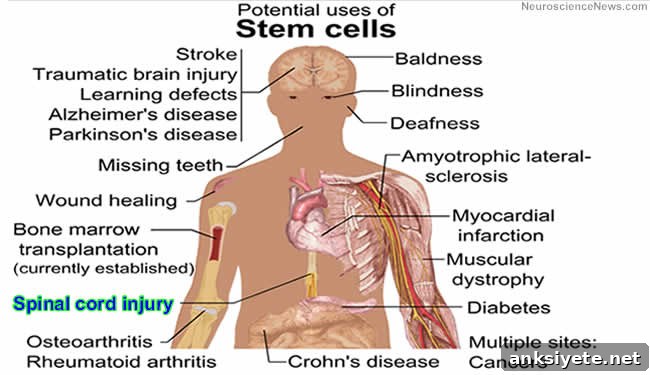
Image Source: Spinal cord injury stem cell image adapted from a public domain image shared by Mikael Häggström
Original Research: Paul Lu et al., “Long-Distance Growth and Connectivity of Neural Stem Cells after Severe Spinal Cord Injury,” Cell, Volume 150, Issue 6, 1264–1273, DOI: 10.1016/j.cell.2012.08.020