
Additional tool accelerates personalized medicine research.
Researchers at Johns Hopkins University have developed a faster way to convert a patient’s skin cells into neural crest–like cells that reproduce many of the biological features of familial dysautonomia, a rare genetic disorder. By combining specific growth conditions, chemical compounds and controlled activation of a single gene, the team can directly generate patient-specific neural crest cells without first taking cells through a full induced pluripotent stem (iPS) cell stage. This direct reprogramming approach shortens the process by months and produces cells that better reflect the disease state, enabling more efficient study of neural crest–related disorders and accelerating personalized therapeutic research.
Previously, the same group relied on first reprogramming patient skin fibroblasts into iPS cells, which resemble embryonic stem cells in their broad developmental potential, and then differentiating those iPS cells into neural crest derivatives. While effective, that method was time-consuming and labor-intensive. The new protocol bypasses the iPS stage entirely—cutting out roughly seven to nine months of work—by directly guiding adult skin cells toward a neural crest fate using reagents that trigger developmental programs in the cells.
Neural crest cells are a transient, multipotent population that arises early in embryonic development. They give rise to many tissues and cell types, including peripheral neurons and supporting glia, pigment-producing melanocytes, craniofacial cartilage and bone, and smooth muscle cells. When neural crest development goes awry, it can cause a variety of congenital conditions. Familial dysautonomia, for example, impairs the autonomic and sensory nervous systems, disrupting regulation of blood pressure, digestion and emotional responses. Although fewer than 500 individuals worldwide are affected by familial dysautonomia, defects in neural crest derivatives underlie many other disorders, from facial malformations to congenital pain insensitivity and certain peripheral neuropathies.
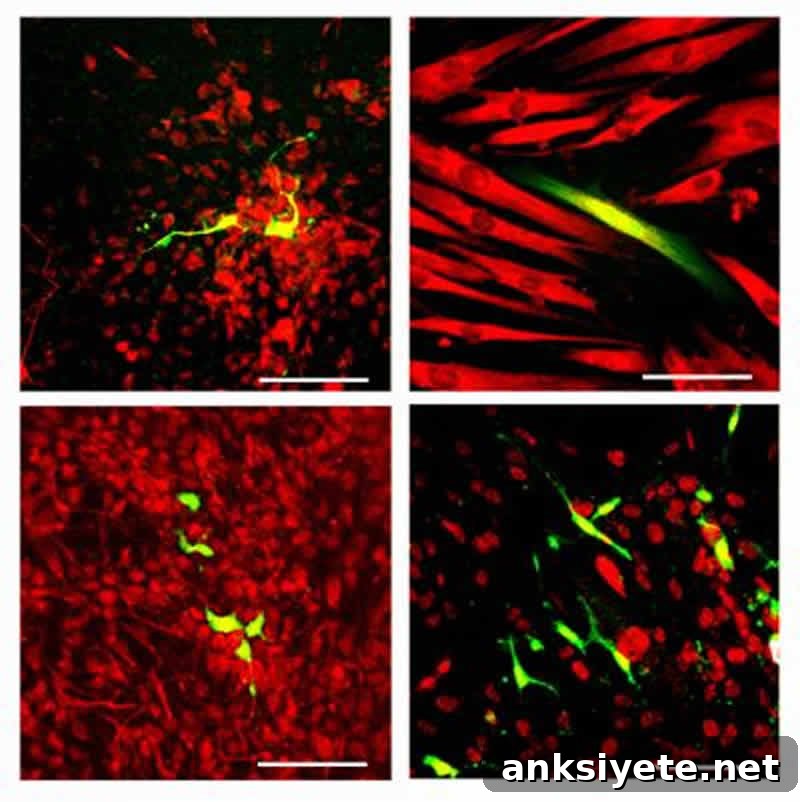
One key element of the protocol is controlled activation of Sox10, a transcription factor that drives the neural crest program. The team genetically engineered fibroblasts to activate Sox10 in response to doxycycline and used a fluorescent reporter to identify cells that had initiated the neural crest gene network. By testing combinations of extracellular matrix proteins, small-molecule additives and transcriptional cues, they identified a culture condition that produced fluorescent neural crest–like cells in about 2 percent of the starting population. That combination included growth on a layer of two distinct proteins and the addition of three small molecules designed to erase parts of the cells’ epigenetic memory and to stimulate developmental signaling pathways.
Single-cell analyses showed that the induced cells express gene patterns consistent with bona fide neural crest identity. Functional assays revealed that approximately 40 percent of the induced cells were quad-potent—able to generate the four major neural crest derivatives tested—while about 35 percent were tri-potent, able to form three of the four lineages. When implanted into early-stage chick embryos, these induced neural crest cells migrated appropriately to locations where developing neural crest cells normally travel, further validating their identity and migratory behavior.
The researchers applied an adapted version of the protocol to skin cells from healthy adult donors and observed similar reprogramming efficiency, indicating the method is robust across different genetic backgrounds. Most importantly, when they generated neural crest cells directly from skin cells of patients with familial dysautonomia and compared them to control cells from healthy donors, the investigators discovered disease-relevant molecular differences. They identified 412 genes that were downregulated in the familial dysautonomia neural crest cells; 98 of those genes are involved in RNA processing, suggesting that altered RNA metabolism may play an important role in the disorder’s cellular pathology.
According to the authors, neural crest cells made by this direct reprogramming route display disease features more faithfully than neural crest cells derived from iPS cells. That fidelity makes them a promising platform for studying the molecular mechanisms of familial dysautonomia in individual patients and for testing candidate therapies in a patient-specific context. The technique should also be adaptable to other congenital conditions that stem from neural crest dysfunction, including congenital pain disorders and certain forms of Charcot-Marie-Tooth disease.
Additional co-authors of the study include Yong Jun Kim, HoTae Lim, Zhe Li, Yohan Oh, Irina Kovlyagina, InYoung Choi and Xinzhong Dong from the Johns Hopkins University School of Medicine. Funding for the research came from the New York Stem Cell Foundation (Robertson Investigator Award) and the Maryland Stem Cell Research Fund (TEDCO).
Contact: Catherine Kolf – Johns Hopkins Medicine
Source: Johns Hopkins Medicine press release
Image Source: Image courtesy of Cell Press, adapted from the Johns Hopkins Medicine press release
Original Research: Abstract for “Generation of Multipotent Induced Neural Crest by Direct Reprogramming of Human Postnatal Fibroblasts with a Single Transcription Factor” by Yong Jun Kim et al., published in Cell Stem Cell (published online August 21, 2014).