
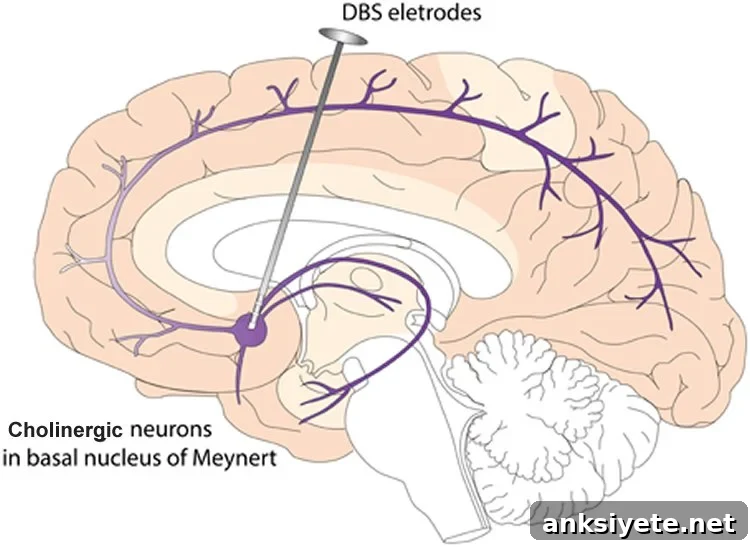
Summary: Intermittent electrical stimulation of the nucleus basalis of Meynert raised acetylcholine levels and improved working memory in adult nonhuman primates, a new study reports.
Source: Medical College of Georgia at Augusta University
Intermittent deep brain stimulation of a small forebrain region that degenerates in Alzheimer’s disease improves working memory, while continuous stimulation can impair it, new primate research finds.
Researchers from the Medical College of Georgia at Augusta University report that brief, repeated pulses of electrical stimulation delivered to the nucleus basalis of Meynert—an area rich in cholinergic neurons that supply acetylcholine to the cortex—boost working memory performance in adult monkeys. By contrast, continuous stimulation of the same region produced worse memory performance, a surprising result given that continuous deep brain stimulation is an established therapy for motor disorders like Parkinson’s disease.
In the study published in Current Biology, intermittent stimulation enabled monkeys to retain information in a standard working memory task up to five times longer than without stimulation. According to Dr. David T. Blake, corresponding author and neuroscientist in the Department of Neurology, the improvement moved many animals from average or poor performers to high performers after repeated sessions.
The investigators implanted ultra-thin electrodes into the nucleus basalis of Meynert to modulate neural activity. Their aim was to increase acetylcholine availability in cortical circuits that underlie attention and working memory. Acetylcholine declines with normal aging and is dramatically reduced in Alzheimer’s disease; current drug treatments that boost cholinergic signaling are limited by modest benefits and widespread side effects.
“Many neural systems adapt to persistent input by downregulating their response,” Blake explains. “Continuous stimulation can lead the system to tolerate or ignore the input. Here we intentionally used intermittent pulses to upregulate cholinergic activity rather than suppress it.”
Experimentally, the most effective pattern was 60 pulses per second delivered for 20 seconds followed by a 40-second pause, repeated in cycles. This intermittent pattern increased acetylcholine in the targeted region and produced robust memory gains. Continuous stimulation, in contrast, often impaired task performance.
The authors confirmed the cholinergic basis of the effect with pharmacology. Donepezil, a cholinesterase inhibitor used clinically to raise acetylcholine levels, restored performance in animals whose memory was degraded by continuous stimulation but did not further improve animals already benefiting from intermittent pulses. Moreover, blocking nicotinic or muscarinic acetylcholine receptors eliminated the improvement produced by intermittent stimulation.
Behavioral testing used a classic delayed-match-to-sample task: a colored square cue appeared briefly, followed by a delay, then a choice between a matching cue and a distractor. Monkeys received a food reward for selecting the correct color. In addition to enhanced performance while stimulation was active, animals showed gradual improvement in unstimulated sessions over months, suggesting longer-term neural changes.
Researchers propose two nonexclusive mechanisms for the lasting benefit: persistent increases in acetylcholine release that modulate synaptic communication and neural excitability, and improved local blood flow that supports metabolic needs. Cholinesterase inhibitors are known to increase regional cerebral blood flow modestly in humans, and blood flow is typically reduced in Alzheimer’s disease. Acetylcholine acts both by changing how neurons communicate—making some cells more active and others less—and by improving perfusion, which delivers oxygen and glucose essential for sustained neural health.
Deep brain stimulation offers a more spatially selective means of enhancing cholinergic signaling than systemic drugs, which activate acetylcholine receptors throughout the body and often cause peripheral side effects such as nausea, appetite loss, muscle cramping and joint pain. The study’s authors note that responses to intermittent nucleus basalis stimulation matched the magnitude of benefit observed with high doses of cholinesterase inhibitors, without the broad systemic exposure.
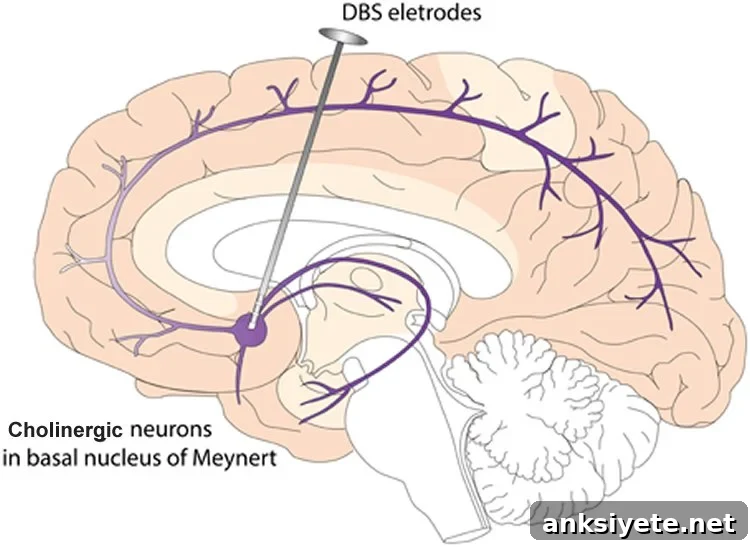
Deep brain stimulation works by supplementing the brain’s native electrochemical signaling. Action potentials traveling along axons trigger release of neurotransmitters like acetylcholine at synapses, influencing nearby neurons and glial cells. Electrical activation of even a single neuron can recruit a local network, amplifying the functional impact. The clinical success of implantable stimulators for cardiac and movement disorders has motivated exploration of similar approaches for cognitive disorders.
The research team has submitted a grant to initiate a clinical trial testing intermittent nucleus basalis stimulation in patients with early Alzheimer’s disease. They emphasize that multiple brain targets and stimulation patterns are currently being evaluated in human trials across the United States and Europe.
Study details: the work was funded by the National Institutes of Health and involved collaborators at Sun Yatsen University (China) and Wake Forest School of Medicine. The full research report is titled “Intermittent Stimulation of the Nucleus Basalis of Meynert Improves Working Memory in Adult Monkeys” and was published online in Current Biology.
Funding: National Institutes of Health.
Source: Toni Baker, Medical College of Georgia at Augusta University.
Intermittent Stimulation of the Nucleus Basalis of Meynert Improves Working Memory in Adult Monkeys
Highlights
• Intermittent stimulation of the nucleus basalis (NB) improves working memory performance.
• Continuous NB stimulation degrades performance in young adult monkeys.
• Donepezil restores performance impaired by continuous stimulation but does not add benefit to intermittent stimulation.
• Effects of intermittent stimulation depend on nicotinic and muscarinic acetylcholine receptors.
Summary
Acetylcholine in the neocortex is critical for executive function. Degeneration of cholinergic neurons in aging and Alzheimer’s disease is commonly treated with cholinesterase inhibitors, but those drugs are modestly effective and have systemic side effects. Here, electrical activation of the nucleus basalis of Meynert—the neocortical source of acetylcholine—was tested in a nonhuman primate working memory model. Intermittent stimulation (60 pulses per second for 20 seconds each minute) significantly improved working memory, while continuous stimulation often impaired it. Pharmacological manipulations confirmed a cholinergic mechanism. Intermittent stimulation also produced performance gains that persisted during some unstimulated sessions, suggesting longer-term functional changes. These results support the potential of targeted intermittent stimulation to restore cognitive function in aging and Alzheimer’s disease.