
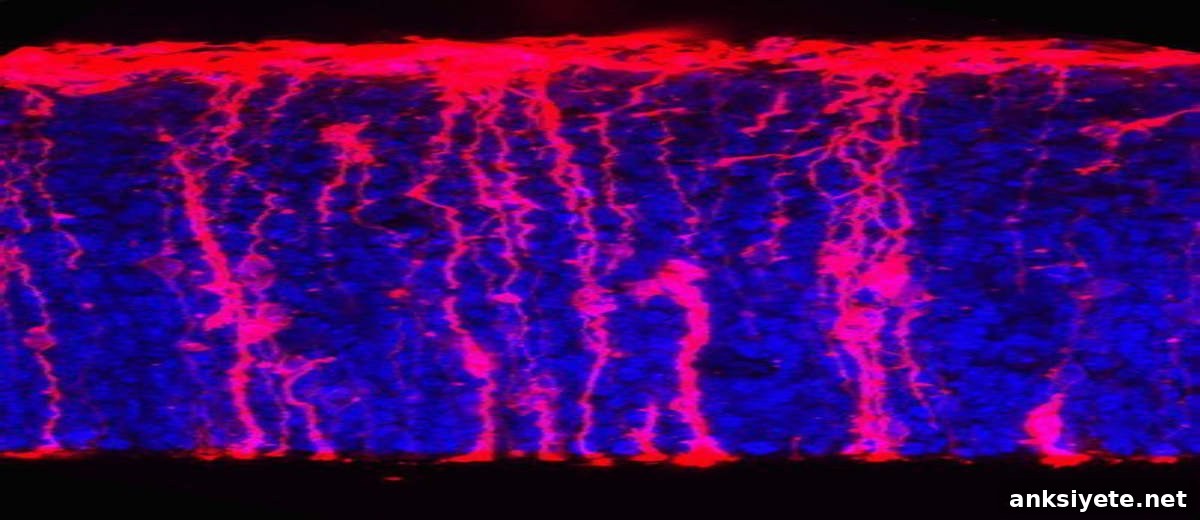
Max Planck researchers explain why iodine deficiency during pregnancy may have disastrous consequences.
The cerebral cortex—the region of the brain responsible for human language, abstract thought and imagination—is much larger in higher mammals like humans than in many other species. Researchers at the Max Planck Institute of Molecular Cell Biology and Genetics in Dresden have identified a cellular mechanism that helps explain how this enlargement arises during development. Their work shows that the expansion of neuron-producing stem cells depends on an interaction between the cells’ surrounding extracellular matrix (ECM), thyroid hormones, and a surface protein called an integrin. This finding clarifies why iodine deficiency in pregnant women, which prevents adequate thyroid hormone production, can have severe and lasting effects on fetal brain development.
Compared with rodents such as mice, the human brain is dramatically larger and more complex. To uncover factors that contribute to these size and complexity differences, the Dresden team, working with colleagues from the Fritz Lipmann Institute in Jena, examined how progenitor cells in the embryonic neocortex divide and produce neurons. They focused on a class of progenitors known as basal progenitors. In humans, basal progenitors have the capacity to expand through repeated cell divisions, generating many neurons and contributing to the growth of the cerebral cortex. In mice, by contrast, these cells typically have limited proliferative capacity, which helps explain the smaller mouse cortex.
A cozy bed for brain stem cells
The researchers discovered that in species with larger brains, basal progenitors are embedded in a supportive extracellular matrix produced by the progenitors themselves. This ECM forms a microenvironment around the cells—like a comfy bed—that helps maintain and stimulate their proliferation. Mice normally lack this rich ECM around their basal progenitors, which restricts their ability to proliferate and produce large numbers of neurons.
To test whether mimicking this environment could boost progenitor proliferation in mice, the team used a stimulating antibody to activate an integrin on the surface of basal progenitors. Integrins are adhesion proteins that mediate signals from the ECM into cells. Activating the integrin simulated the effects of an ECM-rich niche and caused the normally limited mouse basal progenitors to proliferate more, producing additional progenitor cells that could become neurons.
Because thyroid hormones are already known to be critical for normal brain development, the researchers then examined how these hormones influence the ECM-integrin interaction. When thyroid hormone production was blocked in pregnant rats, their embryos showed a marked reduction in basal progenitor proliferation and produced fewer neurons. Importantly, when researchers interfered with the hormone’s action on the integrin, the ECM-mimicking antibody alone no longer stimulated progenitor expansion. These results indicate that both a permissive ECM signal and thyroid hormone signaling are required together to drive the expansion of basal progenitors during cortical development.
In other words, thyroid hormones and ECM-mediated integrin activation act cooperatively to promote the proliferation of neuron-producing progenitors. Human basal progenitors naturally build the appropriate ECM, providing the structural context that, together with thyroid hormones, allows them to expand and generate the increased neuron numbers needed for a larger cerebral cortex. This cooperative mechanism likely contributed to the evolutionary enlargement of the human brain.
The study also provides a cellular explanation for the established clinical observation that iodine deficiency during pregnancy can cause severe neurodevelopmental disorders. Iodine is an essential element required to synthesize thyroid hormones. Without sufficient iodine intake, thyroid hormone levels fall, disrupting the hormonal support that basal progenitors need to respond to ECM signals. The resulting failure in progenitor expansion helps explain the impaired brain growth and neurocognitive deficits associated with conditions such as cretinism, a severe form of developmental impairment historically linked to maternal iodine deficiency.
These findings deepen our understanding of the molecular and cellular interactions that shape cortical development and highlight the critical role of maternal thyroid hormone availability during pregnancy. By linking ECM-integrin signaling with thyroid hormone action, the study points to a mechanistic basis for how nutritional deficiencies in expectant mothers can translate into lasting changes in the structure and function of the developing brain.
Notes about this neurodevelopment and neurogenetics research
Contact: Denise Stenzel – Max Planck Institute
Source: Max Planck Institute press release
Image Source: The image is credited to D. Stenzel/Max Planck Institute and is adapted from the press release.
Original Research: Abstract for “Integrin αvβ3 and thyroid hormones promote expansion of progenitors in embryonic neocortex” by Stenzel, Denise; Wilsch-Bräuninger, Michaela; Wong, Fong Kuan; Heuer, Heike; and Huttner, Wieland B. in Development. Published online February 2014 doi:10.1242/dev.101907
#neurodevelopment, #neurogenetics