
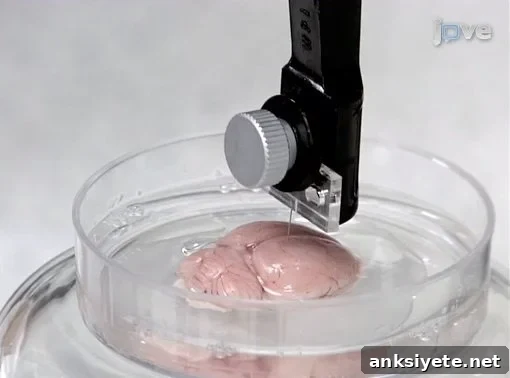
On August 20, JoVE (Journal of Visualized Experiments) will publish a new technique developed by the Capadona Lab at Case Western Reserve University that addresses two central challenges in brain-implant technology: preserving the material changes that occur during implantation and making reliable mechanical measurements at the microscale. These methods will help bioengineers design and evaluate implants that must endure the brain’s physiological environment over long periods.
Dr. Jeffrey R. Capadona, principal investigator of the Capadona Lab, explained: “We created an instrument to measure the mechanical properties of micro-scale biomedical implants after being explanted from living animals.” The technique preserves the altered properties that occur in vivo so they can be measured directly after removal. By providing realistic data that reflect the implant’s condition inside the brain, the method enables more accurate development and testing of materials intended for chronic neural interfaces.
Implanted neural devices face multiple stressors in the brain: temperature fluctuations, moisture, enzymes, and other in vivo factors that can alter their material properties. Changes in stiffness, porosity, or surface chemistry can lead to an increased inflammatory response and ultimately impair the device’s function. “Often, the body’s reaction to those implants causes the device to prematurely fail,” says Dr. Capadona. “In some cases, the patient requires additional surgery to replace or revise the implants.” By monitoring how material properties evolve during implantation, researchers can select or design materials that are less likely to provoke harmful responses and that retain their function longer.
The Capadona Lab’s technique is particularly valuable because it enables direct mechanical testing at micro-scale dimensions. Many conventional methods require much larger samples or rely on extrapolating from nano-scale measurements; scaling those results to predict the behavior of actual micro-scale devices can be unreliable. Measuring explanted microelectrodes and small implant components directly removes a layer of uncertainty in material characterization and gives designers practical data for improving long-term performance.
Microelectrodes chronically embedded in the brain are central to many promising neurotechnologies. Accurately measuring how these microelectrodes change over time can support development of interfaces that read neural signals with greater stability, which in turn could aid efforts to restore motor function for individuals living with spinal cord injury, stroke, or multiple sclerosis. Dr. Capadona notes that chronic neural interfaces hold potential for translating neural activity into assistive control signals—provided the materials and designs remain functional and biocompatible over extended periods.
Capadona and colleagues chose JoVE as the venue to publish their method because JoVE’s video-based format allows researchers to see procedures and instrumentation clearly. “If a picture is worth a thousand words, a video is worth a million,” Dr. Capadona said, underlining the importance of visual demonstration when sharing complex experimental techniques. The visual presentation aims to make adoption of the method easier for other labs working on neural implants and biomaterials.
Notes about this brain implant research
Contact: Rachel Greene – JoVE
Source: JoVEpress release
Image Source: The image is credited to JoVE and adapted from the press release.
Original Research: The original research will be published in JoVE on August 20, 2013. A link to the article will be made available when the publication is released.