
Summary: By changing specific epigenetic markers on chromosomes, researchers observed altered gene expression in offspring and grandoffspring. The study demonstrates clear transgenerational epigenetic inheritance mediated by a histone modification.
Source: UC Santa Cruz
Epigenetic changes can modify how genes are expressed without altering the DNA sequence itself, influencing development and health. Evidence is growing that some of these changes can be passed across generations, but the molecular mechanisms and the extent of that inheritance are still being clarified.
A new study from UC Santa Cruz shows that a common histone modification can be transmitted via sperm not only to direct offspring but also to the next generation. This phenomenon, called transgenerational epigenetic inheritance, offers a mechanism by which the experiences or cellular states of parents and grandparents could shape the biology of descendants.
Published in the Proceedings of the National Academy of Sciences (PNAS), the study focused on H3K27me3, a well-studied epigenetic mark that represses gene activity by changing how DNA is packaged around histone proteins. H3K27me3 is conserved across multicellular animals and was examined in the nematode worm C. elegans, a powerful model for genetic and epigenetic experiments.
Corresponding author Susan Strome, professor emerita of molecular, cell and developmental biology at UC Santa Cruz, explained that the experiments establish a causal link between histone marks carried by sperm and altered gene expression and development in both offspring and grandoffspring. The work isolates the effect of inherited chromatin state from changes to the DNA sequence itself.
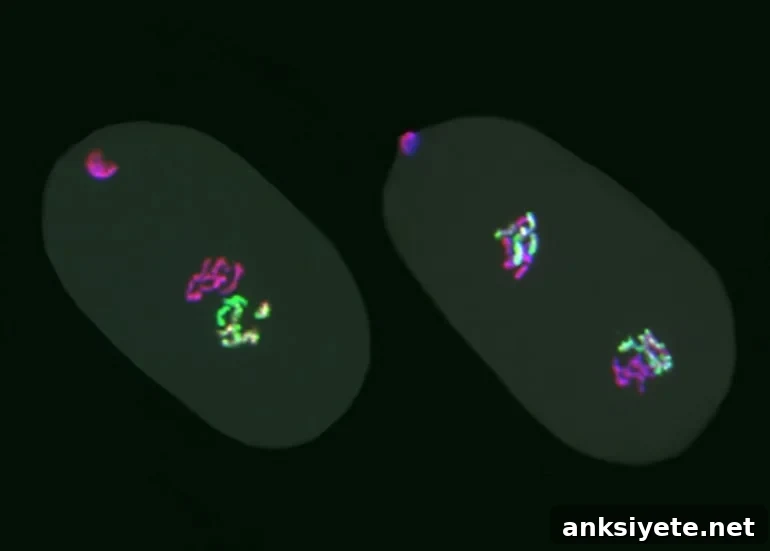
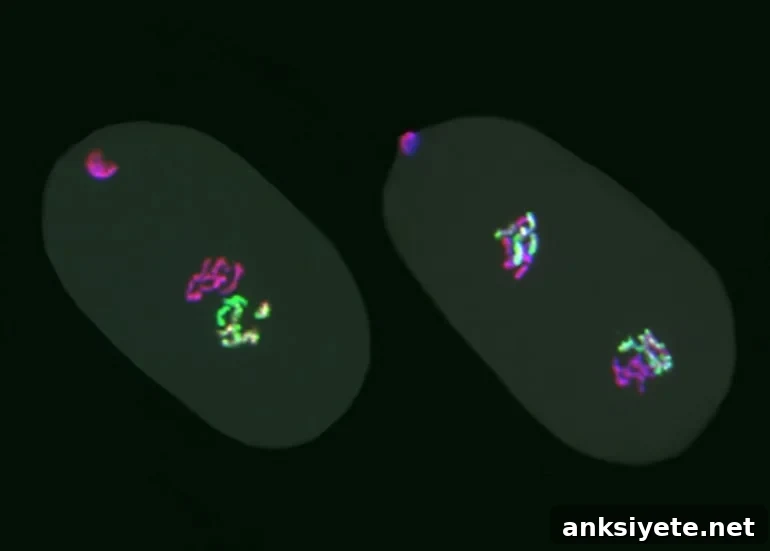
Histones are the core proteins around which DNA winds to form chromatin. The H3K27me3 mark denotes methylation on a particular amino acid of histone H3, which compacts chromatin and reduces access to genes in that region. To test the role of this mark in inheritance, researchers selectively removed H3K27me3 from chromosomes in C. elegans sperm. Those altered sperm then fertilized eggs whose chromosomes retained the normal H3K27me3 pattern.
In the resulting offspring, genes on the paternal chromosomes—those inherited from the sperm lacking H3K27me3—were frequently upregulated compared with their normally repressed state. Different tissues activated different sets of genes, showing that tissue context determined which genes became aberrantly expressed. For example, germline tissue, which normally produces eggs and sperm, in some cases began expressing genes typically restricted to neurons.
Chromosome analysis in offspring germline cells showed that the genes that became upregulated remained in a state lacking the repressive H3K27me3 mark, while other regions of the genome regained the mark. Crucially, this altered pattern in the germline was transmitted into the next generation: some sperm-derived alleles that lacked H3K27me3 and were upregulated in offspring remained H3K27me3(−) and upregulated in grandoffspring.
The team observed a range of developmental outcomes among grandoffspring, including cases of complete sterility. Those variable effects arise because chromosome segregation during gametogenesis can produce many different combinations of marked and unmarked chromosomes, creating diverse epigenetic states that are inherited in different offspring.
Strome noted that similar phenomena have been reported in mammalian cell culture studies, although those studies did not demonstrate multigenerational transmission in whole organisms. The conserved nature of H3K27me3 and its role in gene repression suggest that these findings in C. elegans may reflect a broader biological principle applicable beyond worms.
The paper’s co-first authors are Kiyomi Kaneshiro, who carried out the work as a graduate student in Strome’s lab and is now a postdoctoral researcher, and UCSC research associate Thea Egelhofer. Other contributors include bioinformaticist Andreas Rechtsteiner and graduate student Chad Cockrum. The research was supported by the National Institutes of Health.
These results demonstrate that H3K27me3 can act as a carrier of epigenetic information across generations in C. elegans. If similar mechanisms operate in other animals, inherited chromatin states in germ cells could help explain how parental and ancestral conditions influence descendant development and health.
About this epigenetics research news
Author: Tim Stephens
Source: UC Santa Cruz
Contact: Tim Stephens – UC Santa Cruz
Image: The image is credited to Laura Gaydos
Original Research: Closed access. “Sperm-inherited H3K27me3 epialleles are transmitted transgenerationally in cis” by Susan Strome et al. PNAS
Abstract
Sperm-inherited H3K27me3 epialleles are transmitted transgenerationally in cis
Chromatin states help maintain cell-specific transcriptional programs across cell divisions, preserving cell identity. How chromatin states are inherited through gametes to influence gene expression in subsequent generations is not fully understood. Using C. elegans as a model, the authors generated offspring in which sperm and oocyte alleles differed in the repressive histone modification H3K27me3. These alleles adopted distinct transcriptional states within the same nuclei of offspring. Sperm alleles that were inherited without H3K27me3 were prone to up-regulation in both somatic and germline tissues of offspring, with tissue context determining which genes were affected. A subset of sperm alleles that became up-regulated in offspring germlines retained the H3K27me3(−) state and were transmitted to grandoffspring as H3K27me3(−) and up-regulated epialleles, demonstrating that H3K27me3 can serve as a transgenerational epigenetic carrier in C. elegans.